

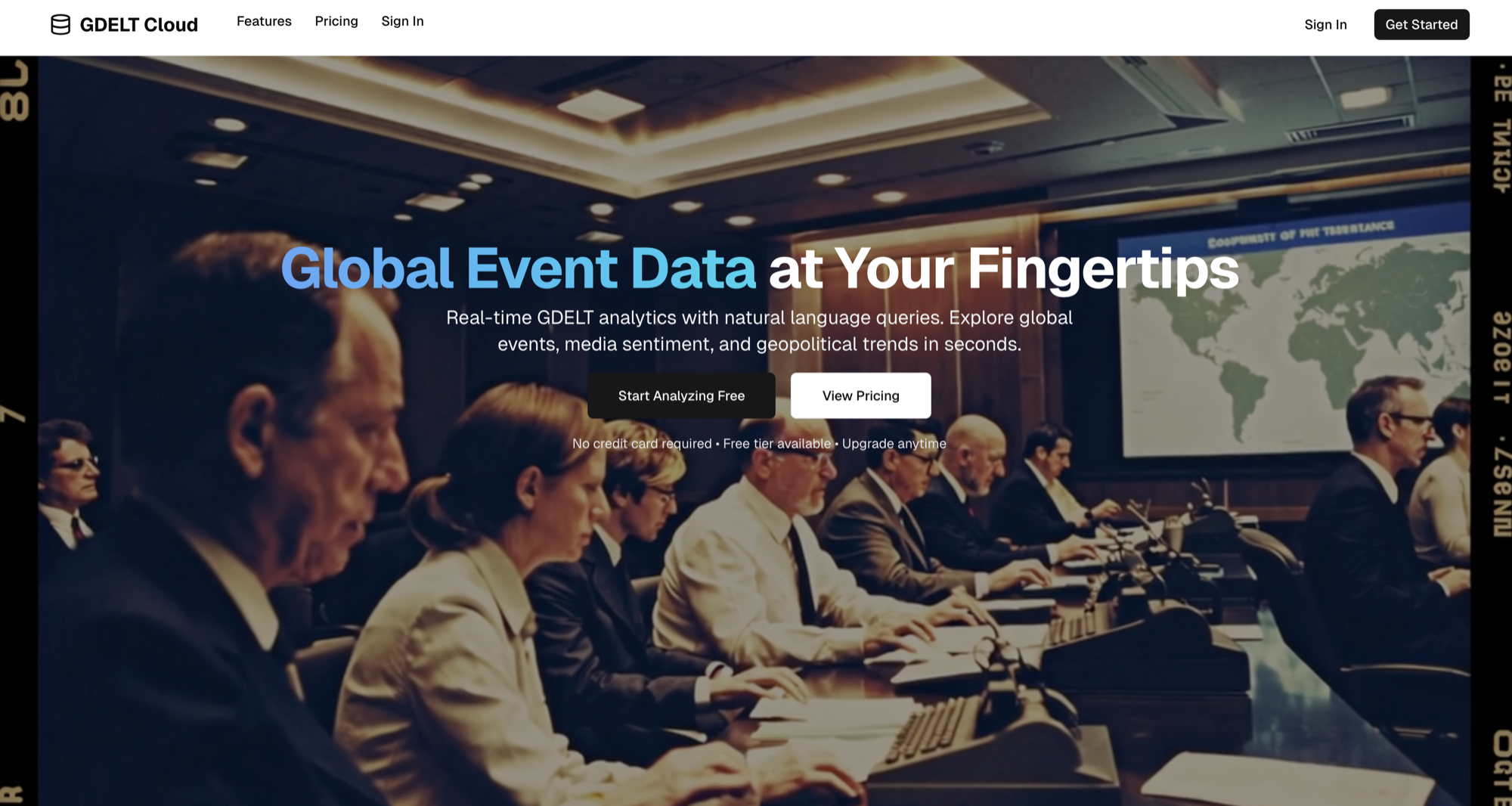
What is GDELT Cloud?
GDELT Cloud provides instant access to global news event data through a powerful API and AI-powered tools. Our data currently extends back to January 2025 and accumulates daily as new events are processed. We are also gradually adding historical data to extend coverage further back in time. Data updates every hour, giving you near real-time access to what’s happening around the world.Research Agent
Ask questions about global events in plain English and get instant insights powered by AI.
REST API
Programmatic access to media events, entity profiles, and domain data via the Developer API.
MCP Server
Connect AI agents directly to GDELT data using the Model Context Protocol.
API Keys
Generate API keys for programmatic access on Analyst and Professional plans.
How the Data Works
GDELT monitors news sources worldwide and extracts structured information from every article it processes. Here’s how the data flows:Articles
Articles
GDELT ingests news articles from thousands of sources in over 100 languages. Each article is captured with its URL, title, publication date, source domain, language, and other metadata.
Events
Events
From each article, GDELT extracts structured events — who did what to whom, where, and when. Events are coded using the CAMEO taxonomy with actors, action types, locations, and intensity scores (Goldstein scale from -10 conflict to +10 cooperation).
Media Events (Story Clusters)
Media Events (Story Clusters)
Related articles covering the same story are grouped into Media Event clusters. Each cluster represents a single news story with aggregated metrics from its underlying events — giving you a story-level view of what happened, who was involved, and how it was covered across sources.
Entities
Entities
People and organizations mentioned in articles are linked to Wikipedia via the GDELT Entity Graph (GEG). Entities carry sentiment scores, salience (how central they are to articles), and are connected to the story clusters they appear in — plus co-occurrence relationships with other entities.
Conflict Events
Conflict Events
News clusters covering political violence, armed conflict, and protests are automatically coded into ACLED-style conflict event records by AI. Each event captures the event type (battle, airstrike, protest, etc.), actors involved, location at up to 4 levels of precision, fatality count, and a narrative summary — linked back to the source news cluster. Coding follows the ACLED methodology.
What You Can Do
Discover Top Stories
Browse the biggest media events of the day or week, filtered by topic, region, or event type.
Deep-Dive Into Stories
Explore a story cluster to see all covering articles, key entities, and apply country/language/source filters.
Profile Entities
Look up any Wikipedia-linked person or organization to see their linked stories, co-occurring entities, and activity timeline.
Analyze News Sources
Profile news domains to see their publication stats, top covered entities, and recent articles.
Track Conflict Events
Browse AI-coded ACLED-style conflict and political violence events with geographic filtering, actor coding, and links to source news clusters.
Get Started
Create an account
Sign up at gdeltcloud.com/auth/sign-up to get started with a free account.
Explore the dashboard
Use the Research Agent to ask questions about global events or browse the Media Events feed.
Use Cases
Conflict Monitoring
Track protests, military actions, and diplomatic events across any region.
Media Analysis
Analyze news coverage patterns, sentiment, and entity mentions across global media sources.
Risk Assessment
Monitor geopolitical risks, social unrest, and emerging conflicts for business intelligence.
Academic Research
Access structured event data for social science, political science, and international relations research.
Quickstart Guide
Follow our quickstart guide to make your first query in under 5 minutes.
GDELT Data License: All GDELT data is freely available for research and analysis. GDELT Cloud provides tools to make this data more accessible.